What credit ratings measure, and what they miss
A AAA rating is not a stamp of quality on a company. It is an opinion on one narrow question: will this debt be repaid on time? Knowing the limits of that question is what makes a rating useful.
Gajji Srinath, Founder, The Valuation Node
Key takeaways
- A rating is an opinion on timely repayment of a specific debt, not on the company's quality or share price.
- Ratings tend to lag events, especially when funding conditions change quickly.
- Read the rating rationale, liquidity assessment and rating sensitivities, not just the symbol.
- Use a rating as the start of your own cash flow and debt analysis.
A rating is not a report card
When people see "AAA", they often read it as a verdict on the company: well managed, strong, safe to own. That reading is wrong in an important way.
A credit rating answers a narrow question. How likely is it that this borrower will pay interest and principal on this specific debt, in full and on time? It says nothing direct about whether the shares are fairly priced, whether the business is growing, or whether the bond is a good buy at today's price.
Keeping that narrow question in view explains both what ratings do well and where they fail.
The question a rating answers
In India, credit rating agencies are regulated by SEBI. CRISIL, ICRA, CARE Ratings and India Ratings are among the registered agencies. They rate specific instruments: a bond, a bank loan, a commercial paper programme.
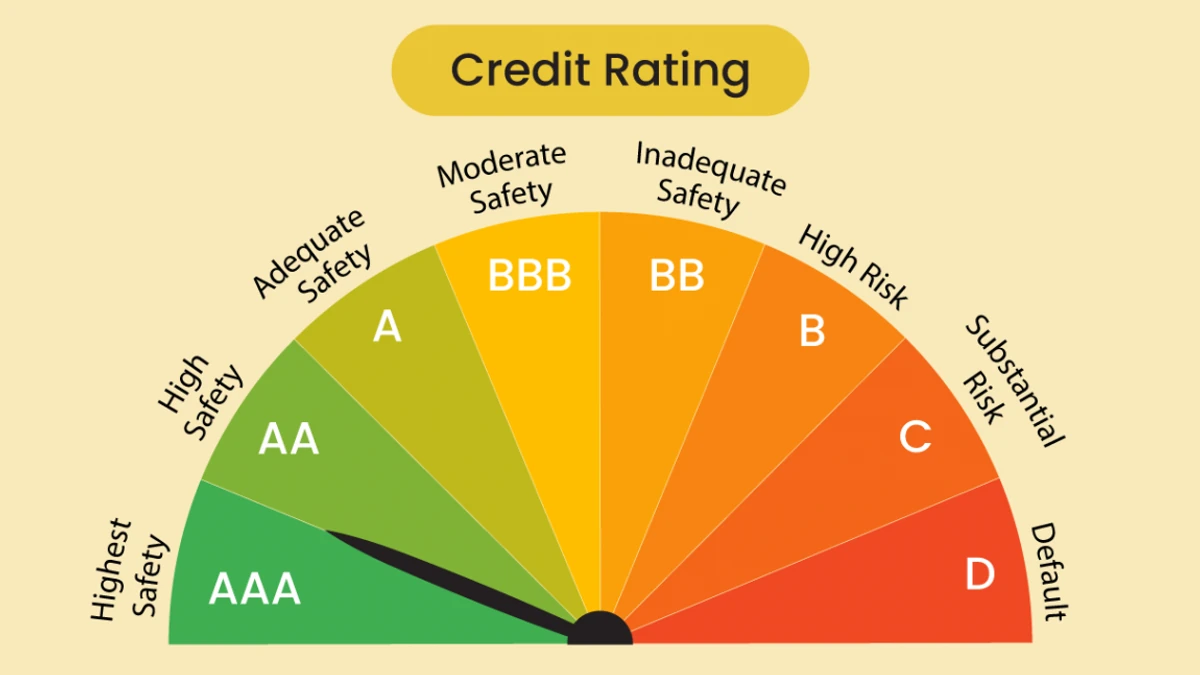
Long-term ratings run from AAA (highest safety) through AA, A, BBB, BB, B and C, down to D, which means default. BBB- and above is called investment grade. Short-term instruments use a separate scale, with A1+ at the top. Each rating carries an outlook (stable, positive or negative), and an agency can place a rating on "watch" when an event could change it soon.
To reach a rating, analysts look at:
- Business risk: industry conditions, market position, scale and diversity of revenue.
- Financial risk: leverage, interest coverage, and cash flow relative to debt.
- Liquidity: cash, unused bank lines and near-term repayments.
- Management and support: track record, governance, and whether a parent or group is likely to step in.
Agencies also publish default studies, which show how often instruments in each category have defaulted over time. Over long periods, these generally show what you would expect: lower ratings default more often. So a rating is best read as a ranking of default risk, not a precise probability.
Blind spots built into the model
Ratings move after the news. Agencies update ratings as information arrives, and that information often arrives late. The clearest Indian example is IL&FS. Its long-term debt carried top-tier ratings until shortly before it began defaulting in 2018. The downgrades came fast, but they came after the stress was already visible in the market.
The issuer pays. Under the standard model, the company being rated pays the agency. That creates a pull toward generous ratings and a temptation for issuers to shop for the best one. SEBI requires agencies to disclose ratings that issuers did not accept, partly to discourage this.
Default is not the same as loss. A rating mainly addresses the chance of default. How much a lender recovers after a default depends on security, seniority and the legal process, and that can differ a lot between two bonds with the same rating.
Support is not the same as strength. Some ratings rely on a guarantee, a pledge of shares or another form of credit enhancement. In India these carry a "CE" suffix, and the agency must also disclose the unsupported, standalone rating. If the standalone rating is much lower, the safety comes from the structure, not from the borrower.
Liquidity can vanish faster than a rating changes. Ratings broadly assume a borrower can refinance. When funding markets freeze, as they did for many NBFCs in 2018, a company's real position can worsen within weeks.
Downgrades can feed on themselves. Many investors, including mutual funds and insurers, face limits on how much low-rated debt they can hold. Some loan agreements also contain rating triggers that speed up repayment after a downgrade. So a downgrade can force selling and tighten funding, which then makes default more likely. In April 2020, Franklin Templeton wound up six of its Indian debt schemes when heavy redemptions met an illiquid bond market, with several holdings already downgraded.
A rating says nothing about price. A correctly rated AA bond can still be a poor investment if its yield is too low for the risk. The rating is one input to that judgment, not the judgment itself.
The real value of ratings
None of this makes ratings worthless. They apply a consistent method across thousands of issuers, which makes comparison possible. Rating analysts often have access to management and information that outside readers do not. Their published rationales are among the most useful free documents on any Indian company with debt. And across large samples, the ranking broadly holds.
The mistake is treating a rating as the end of the analysis rather than the start.
Reading a rating properly
- Read the rationale, not the symbol. Every rating comes with a press release that explains the key rating drivers.
- Check the liquidity assessment. Rationales classify liquidity, for example as strong, adequate, stretched or poor. A high rating with stretched liquidity deserves attention.
- Read the rating sensitivities. Agencies state what could trigger an upgrade or a downgrade. Treat these as a checklist of what to monitor.
- Look for the CE suffix and compare the standalone rating.
- Compare agencies and watch the market. If a company's bond yields or commercial paper rates rise well above others with the same rating, the market may be ahead of the agencies.
- Do your own cash work. Interest coverage, debt to EBITDA, and the debt maturity profile against expected cash flow. A rating cannot replace that.
The reframe
A rating tells you how a careful outsider ranked the odds of repayment on the day they last looked. Your job is to ask what has changed since then.
Sources
Figures and claims come from the sources named in the text and in the methodology note above: company filings, exchange disclosures, and rating agency reports, as cited. See the editorial philosophy for how sources are chosen.
Cite this article
Gajji, S. (2026). "What credit ratings measure, and what they miss." The Valuation Node. https://valuationnode.com/analysis/financial-analysis/what-credit-ratings-measure-and-miss
Related
What a 25bps RBI Hike Does to a Levered Company
A 25 basis point hike looks tiny. For a heavily indebted company, it can cut profit by several percent, and the effects that follow are larger.
CreditGreen Bonds vs. Sustainability-Linked Bonds: How the Structures Differ
Green bonds tie the money to projects; sustainability-linked bonds tie the coupon to targets. How each works, what can go wrong, and how India regulates them.
MarketsIPO Issue Price vs. Listing Price vs. Subsequent Performance
Seven of India's most talked-about IPOs since 2021, tracked from issue price to listing to October 2026. Buying on listing day lost money in six of seven.
Discussion
Commenting as a guest. Add a name if you like, or leave it blank to post as Anonymous. Log in to comment as yourself.
Educational analysis, not investment advice. The author may hold positions in securities discussed; where relevant, this is stated above. See the disclaimer.
Stay in the loop
Roughly one email per month. No spam, no upsells.