
Financial analysis
How to Value a Company Using a Discounted Cash Flow Model
A DCF is not a formula you feed numbers into. It is a story about a business, written in cash flows. This walk-through builds one step by step.
5 min readRead more
15 pages carry this tag.
A DCF is not a formula you feed numbers into. It is a story about a business, written in cash flows. This walk-through builds one step by step.

A common approach is to value a company and then add or subtract a little for its ESG score. A better approach puts each material ESG issue into the model where it actually changes value.
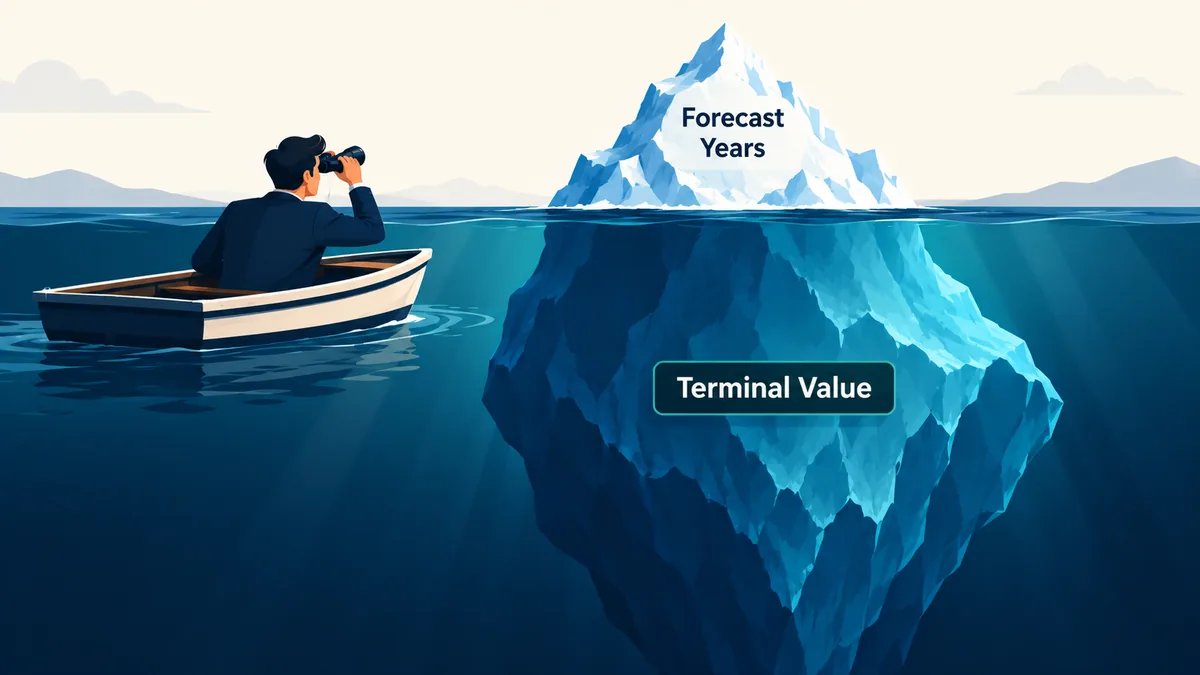
Analysts spend hours forecasting five years of cash flows, yet most of a DCF's answer usually comes from one number at the end. Here is why, and what to do about it.

WACC looks like a precise input, but it is built from four estimates, each with a range. A one-point change can move a value by 10% to 25%, depending on when the company's cash arrives.
Why ₹100 today is worth more than ₹100 next year: future value, present value, NPV, annuities, compounding and perpetuities, with the formulas.
Estimating the cost of equity with CAPM, the after-tax cost of debt and WACC for an Indian company, with a worked example.
How companies decide which long-term investments to make: NPV, IRR and payback, incremental cash flows, MIRR, real options and capital rationing.
How a DCF values a business: FCFF and FCFE, building the model step by step, multi-stage models, sensitivity tables and ESOP dilution.
The two ways to estimate terminal value, Gordon growth and exit multiple, how to cross-check them, and why it dominates a DCF.
Ten common DCF mistakes, from a terminal growth rate above WACC to stale betas and false precision, and how to avoid each one.
Start from today's price and solve for the growth it needs. How to run a reverse DCF, an illustrative worked example, and how to judge whether the implied growth is realistic.
Start from scratch and build a complete discounted cash flow model for a real Indian company, one concept at a time.
Find the present value of a future sum, given a discount rate and time horizon.
Compute the weighted average cost of capital from equity and debt weights, their costs, and the tax rate.
Two-stage DCF model with live sliders, a 5x5 sensitivity grid across WACC and terminal growth, and Excel export.
Related topics: Valuation, Relative valuation, Cost of capital, Financial statements, Cash flow, Earnings quality, Red flags, Ratios